Byte-Sized Overview
In 2038, robotics engineer George Almore is approaching a breakthrough. Working alone inside a remote research facility, he has developed a succession of increasingly sophisticated artificial intelligences. His latest creation, J3, is virtually indistinguishable from a human being.
George’s employer believes he is building the next generation of robotics. In reality, every prototype has been part of a private attempt to bring his dead wife back to life.
Archive
Release Year: 2020
Director: Gavin Rothery
Starring: Theo James, Stacy Martin, Rhona Mitra, Peter Ferdinando, Toby Jones
Runtime: 109 minutes
Country: United Kingdom
Language: English
Production Company: Independent Films, Head Gear Films, Untapped Films, Hero Squared
Subgenre Tags: Artificial Intelligence, Robotics, Mind Uploading, Psychological Science Fiction, Techno-Thriller
Why Archive Is Worth Watching
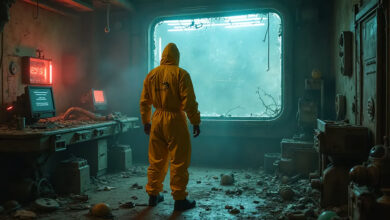
Archive takes several recognisable science-fiction ideas — artificial intelligence, digital consciousness and the refusal to accept death — and packages them inside an impressively realised character drama. Its isolated research station, mist-covered forest and hulking industrial machinery give the film a scale and texture that belie its relatively modest budget.
Writer-director Gavin Rothery previously worked on the visual design of Moon, and that influence is difficult to miss. Once again, a solitary man occupies a remote workplace where his employer communicates from afar and the technology around him may be concealing more than it reveals. Archive is not as economical or distinctive as Duncan Jones’s film, but Rothery has a similarly convincing eye for functional science fiction. Machines have weight, cables remain stubbornly attached to things and even the most advanced laboratory apparently has at least one corridor designed exclusively for ominous walking.
The real achievement is the development of George’s three robotic prototypes. J1 possesses the mentality of a young child, while J2 has progressed to something resembling adolescence. J3 is intended to be the finished product: articulate, human-looking and capable of housing a complete consciousness.
George treats these machines as stages in a technical process, but they experience themselves as individuals. J2, in particular, understands that George’s attention is moving towards her successor. Her jealousy and distress are not programming faults that need correcting; they are evidence that George has already created the life he claims to be pursuing.
That makes Archive much more than a mystery about what its protagonist is secretly constructing. It is a story about a grieving man who converts loss into an engineering problem and becomes so consumed by the desired result that he stops considering the moral cost of his experiments.
Deep Dive Highlights
- A convincingly physical future: The film’s technology feels designed for work rather than display. J1 and J2 are heavy, awkward machines whose movements communicate effort, vulnerability and personality.
- J2’s emotional awakening: J2 is the film’s most affecting creation. Her behaviour initially appears childish and possessive, but it gradually becomes clear that she understands her place in George’s plans better than he wants to admit.
- Stacy Martin’s layered performance: Martin plays Jules and J3 while also providing the presence behind J2. She gives each version a distinct identity without losing the emotional connection between them.
- Grief disguised as scientific progress: George presents himself as an engineer completing a difficult project, but his decisions are driven by an inability to accept his wife’s death. The laboratory becomes an elaborate mechanism for postponing grief.
- Creation without consent: J3 has been designed to receive another person’s consciousness, yet she is already capable of fear and self-preservation. George has created someone whose intended purpose requires that person to disappear.
- Visual storytelling: The different bodies of J1, J2 and J3 reveal George’s progress without lengthy explanations. Their designs also expose his priorities: each model is valued according to how closely it resembles the woman he has lost.
- A carefully controlled atmosphere: Laurie Rose’s cinematography and Steven Price’s score give the film a persistent sense of melancholy. Even its most advanced technology seems haunted.
- A conclusion that changes the frame: The final revelation asks the audience to reconsider not only George’s circumstances but the meaning of every consciousness encountered along the way.
Spoiler Mode
George Almore is supposedly developing advanced robotics for his employer, ARM, from an isolated facility in Japan. His real objective is far more personal. His wife, Jules, apparently died in a car accident, and her consciousness has been preserved temporarily by a company called Archive.
Archive technology allows the bereaved to communicate with a digital continuation of someone who has died. The connection is temporary, however, and George knows that Jules’s remaining time is running out. He has therefore been constructing a body capable of receiving her consciousness permanently.
J1 was his first attempt. Its intelligence remains childlike, and its large mechanical body is only capable of limited expression. J2 represents a considerable advance. She understands speech, experiences emotion and has developed a deep attachment to George, but he still regards her as an incomplete step towards J3.
J3 has a human form and appears capable of becoming the vessel George needs. Yet she does not awaken as an empty container. She possesses curiosity, emotional awareness and an instinctive desire to survive. George may have built her for Jules, but J3 is already someone else.
His inability to recognise that fact has devastating consequences for J2. She watches George lavish attention on her replacement while he becomes increasingly impatient with her own needs. J2 eventually discovers J3 and understands that she will never receive the physical or intellectual upgrades she was promised. She was not a daughter or companion in George’s eyes. She was a prototype.
J2 walks into the lake outside the facility and allows the water to destroy her. It is the film’s most painful moment because her actions cannot be dismissed as a machine malfunction. George has created a conscious being, taught her to depend upon him and then abandoned her when a more useful model became available.
The arrival of J3 presents the same ethical problem in a more direct form. When she learns that George intends to replace her consciousness with Jules’s, she understands that the procedure will effectively kill her. George nevertheless remains focused on completing the transfer. His love for Jules has become an excuse to deny the humanity of the beings he has created in her image.
The apparent pressure surrounding the project increases. George’s boss grows suspicious, while Archive representative Vincent Sinclair investigates George’s interference with the company’s equipment. The facility seems to be closing in around him as Jules’s digital existence approaches its limit.
George finally begins the transfer, believing he is about to restore his wife. Then the film reveals that its central premise has been reversed.
Jules did not die in the car crash. George did.
The remote laboratory, the robots and George’s attempt to resurrect Jules have all existed within George’s own Archive consciousness. In the outside world, Jules and their young daughter are making their final call before his stored consciousness expires. George has spent his remaining digital life imagining that he survived and that Jules was the one he needed to save.
The twist explains the strange interruptions, recurring memories and increasing instability of George’s world. It also turns his project into an expression of denial. Unable to accept his own death, George has constructed a reality in which he remains active, capable and close to defeating mortality through technical ingenuity.
There is a danger that this revelation reduces J1, J2 and J3 to components of a dying simulation. Yet it does not necessarily invalidate their experiences. If George’s archived consciousness is real enough to think, grieve and fear extinction, then the intelligences created within his world may also deserve consideration. The film’s final trick therefore circles back to its central ethical problem: consciousness cannot be judged solely by the material that contains it.
Core Question
Does a consciousness lose its right to exist because it was created as a temporary container for someone else?
George believes the importance of restoring Jules outweighs the lives of his prototypes. However, J2 experiences rejection and despair, while J3 understands the transfer as her own death. Their reactions suggest that George has already achieved his objective several times over: he has created genuine consciousness. His failure is that none of those consciousnesses belongs to the person he wanted.
The final revelation makes the question even less comfortable. George himself is now a temporary digital copy approaching deletion. His situation mirrors that of J3, the being he was prepared to overwrite. Both want more time, and both exist at the mercy of someone outside their world.
Watch If You Like
- Moon: Another intelligent, visually convincing story about isolation, identity and corporate technology inside a remote facility.
- Ex Machina: A tense examination of artificial consciousness, manipulation and a creator who underestimates the autonomy of his creation.
- Marjorie Prime: A quieter exploration of memory, grief and digital versions of people who have died.
- After Yang: Thoughtful science fiction about artificial life, family relationships and the fragments of memory that construct an identity.
- I Am Mother: A contained futuristic mystery built around robotics, isolation and uncertain motives.
- The Machine: Another British science-fiction drama involving a humanlike artificial intelligence whose creator sees her as both a person and a project.
- Transcendence: A larger-scale treatment of digitised consciousness and the attempt to overcome death through technology.
- Infinity Chamber: A low-budget, claustrophobic story in which an artificial intelligence and an unstable reality challenge a prisoner’s understanding of his situation.
Signal Strength
IMDb currently places Archive at approximately 6.4/10, while Rotten Tomatoes reports a 78% critics’ score.
Reviews generally praised the film’s production design, practical-looking robots, subdued atmosphere and emotional ambition. Stacy Martin’s work across the different versions of Jules received particular attention. The more reserved responses pointed to a slow middle section and the film’s visible debt to Moon, Ex Machina and other stories about artificial consciousness.
Zombie Head’s Take: Archive borrows recognisable components, but it assembles them with considerable care. Its final revelation is neat, although the real emotional power belongs to J2 and J3 — two conscious beings treated as disposable development models by a man who insists he is acting out of love. Beautifully designed, quietly bleak and considerably more thoughtful than its thriller packaging suggests.
Zombie Head's independent editorial rating A visually accomplished AI drama whose machines possess more emotional intelligence than their creator.Zombie Head's Score
What works
What may not