Byte-Sized Overview
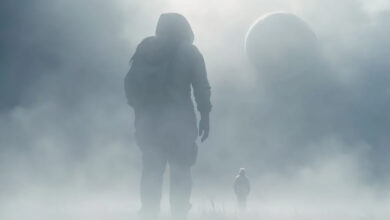
A silver spacecraft descends over Washington, D.C., bringing everyday life to a halt as it lands in a public park. From it emerges Klaatu, a human-looking visitor who claims to have travelled more than 250 million miles to deliver an urgent message to every nation on Earth.
Klaatu is accompanied by Gort, a towering robot with the power to neutralise humanity’s weapons almost instantly. Although Klaatu repeatedly insists that he has arrived peacefully, fear, military suspicion and political rivalry prevent him from addressing the world as one civilisation.
Escaping official custody, Klaatu adopts the name Mr Carpenter and moves into a boarding house. His friendship with young Bobby Benson and Bobby’s widowed mother, Helen, gives him an opportunity to observe ordinary human life while searching for someone capable of helping him deliver his warning.
Released during the early years of the Cold War, The Day the Earth Stood Still rejected the era’s familiar image of the alien invader. Humanity is the potential threat, and the visitor from another world has come to decide whether it can control its increasingly destructive technology.
The Day the Earth Stood Still
Release Year: 1951
Director: Robert Wise
Starring: Michael Rennie, Patricia Neal, Hugh Marlowe, Sam Jaffe, Billy Gray, Lock Martin
Runtime: 92 minutes
Country: United States
Language: English
Production Company: 20th Century Fox
Subgenre Tags: Alien Contact, Cold War Science Fiction, Robots, Social Science Fiction, Nuclear Weapons, Space Travel
Why The Day the Earth Stood Still Is a Sci-Fi Icon
The Day the Earth Stood Still appeared when cinematic visitors from space were usually monsters, conquerors or convenient symbols of communist infiltration. Klaatu offered something more challenging: an alien whose civilisation appears peaceful and rational, but whose patience with humanity has strict limits.
Michael Rennie’s controlled performance gives Klaatu authority without making him cold. He observes human behaviour with curiosity and disappointment, gradually discovering that kindness and intelligence exist alongside fear, aggression and self-interest. His calm delivery makes the message more powerful than a conventional display of anger.
Robert Wise directs the film with documentary-like restraint. Radio reports, military movements and public reactions make the spacecraft’s arrival feel like a real national emergency. The grounded presentation allows the story’s philosophical concerns to emerge without losing the tension of a science-fiction thriller.
Patricia Neal gives Helen Benson an essential role in bridging the distance between Klaatu and humanity. Helen is prepared to listen even when doing so places her in danger, while Bobby’s openness allows Klaatu to experience the species without government officials and armed soldiers controlling every interaction.
Gort remains one of science fiction’s most recognisable robots. Silent, physically imposing and almost indestructible, he represents technological power stripped of emotion and personal ambition. The unsettling question is not whether Gort might malfunction but whether he will operate exactly as intended.
The film’s warning about nuclear weapons belongs unmistakably to the early Cold War, but its wider argument has not dated. Technological power continues to develop faster than political cooperation, while nations still struggle to approach global dangers as shared problems.
Its final solution is deliberately uncomfortable. Klaatu speaks for a civilisation that has eliminated war by transferring ultimate authority to machines capable of destroying any aggressor. Peace has been achieved, but under a threat so absolute that nobody can afford to test its limits.
Zombie Head would undoubtedly support fewer nuclear weapons, although placing an eight-foot robot in charge of disciplinary matters feels like a policy deserving at least one committee meeting.
Deep Dive Highlights
- The Alien as Messenger: Klaatu has not come to conquer Earth or steal its resources. His purpose is to assess whether humanity’s technological development has made it a danger to neighbouring worlds.
- Michael Rennie’s Klaatu: Rennie avoids exaggerated alien mannerisms, playing Klaatu as calm, intelligent and observant. His humanity makes the failures of the actual humans around him more conspicuous.
- Gort: The robot’s smooth, featureless design avoids visible machinery and unnecessary movement. Its stillness creates the impression of overwhelming power held under perfect control.
- Cold War Anxiety: The inability of governments to agree upon a meeting place becomes evidence of the division Klaatu has come to address. International rivalry prevents humanity from hearing a message concerning its collective survival.
- Science Against Politics: Professor Barnhardt responds to Klaatu through evidence, calculation and reason. While officials concentrate upon control and security, the scientist considers what the visitor’s arrival means for the entire planet.
- Helen and Bobby Benson: The mother and son provide Klaatu with direct contact with ordinary human life. Their decency prevents his assessment of humanity from being based entirely upon soldiers, politicians and excitable boarding-house gossip.
- Bernard Herrmann’s Score: Theremins, electronic instruments, brass and percussion produce a sound that became enormously influential upon later science-fiction cinema. The music makes Klaatu’s arrival feel both mysterious and momentous.
- A Grounded Washington: Familiar streets, landmarks and government buildings give the story credibility. The extraordinary spacecraft is made more convincing by placing it within an otherwise recognisable world.
- Controlled Special Effects: The film uses effects sparingly, concentrating on the spacecraft, Gort’s weapon and the global demonstration. This restraint helps the technology retain its mystery.
- Peace Through Deterrence: Klaatu’s civilisation has prevented war by giving robots the authority to destroy aggressors. The system mirrors nuclear deterrence while taking it to a terrifyingly efficient conclusion.
Spoiler Mode
Klaatu’s peaceful arrival immediately goes wrong. When he produces a small device as a gift for the President, a nervous soldier mistakes it for a weapon and shoots him. Gort responds by emerging from the spacecraft and using a beam from behind his visor to destroy the soldiers’ weapons.
Klaatu stops Gort before anyone is harmed. He explains that the destroyed object was intended to assist the study of life on other planets, making humanity’s first response to advanced knowledge an act of frightened destruction.
While recovering in hospital, Klaatu asks government representative Mr Harley to arrange a meeting involving the leaders of every nation. Harley explains that political tensions make such a gathering impossible because the governments cannot agree upon its location or conditions.
Realising that official channels will not allow him to complete his mission, Klaatu escapes from the hospital and adopts the identity Mr Carpenter. He takes a room at the boarding house where Helen Benson lives with her son, Bobby.
Bobby shows Klaatu around Washington and takes him to Arlington National Cemetery, where his father is buried. Klaatu is disturbed that so many young people have died in wars. When Bobby identifies Professor Jacob Barnhardt as the greatest living person, Klaatu decides to seek his assistance.
At Barnhardt’s home, Klaatu completes a difficult equation on the professor’s blackboard. The intervention convinces Barnhardt that his visitor possesses knowledge beyond contemporary human science.
Klaatu reveals his identity and explains the purpose of his visit. Earth’s development of atomic weapons would not concern other worlds if humanity remained confined to its own planet. The combination of nuclear weapons and space travel, however, means human aggression could soon threaten the wider interplanetary community.
Barnhardt agrees to gather leading scientists and intellectuals near Klaatu’s spacecraft. He also suggests that Klaatu provide a harmless demonstration of his power so that governments cannot dismiss his warning.
At noon, almost every electrically powered machine on Earth stops for thirty minutes. Cars, factories, household appliances and communications systems cease functioning, while aircraft in flight, hospitals and other services necessary to protect life remain unaffected.
The demonstration proves that Klaatu could disrupt human civilisation without indiscriminate destruction. It also produces the event described by the film’s title: the Earth itself does not stop moving, but the technological world built upon it is forced into sudden silence.
Bobby follows Klaatu and sees him communicate with Gort. After Bobby reports what he witnessed, Helen begins to accept that Mr Carpenter is the alien visitor. Her boyfriend, Tom Stevens, instead sees an opportunity for personal recognition and informs the authorities.
Knowing that soldiers are closing in, Klaatu gives Helen a vital instruction. If anything happens to him, she must reach Gort and say, “Klaatu barada nikto.” Klaatu warns that without this command, the robot could respond to his death by destroying Earth.
Soldiers corner Klaatu and shoot him. Helen reaches the spacecraft as Gort awakens and begins neutralising the surrounding military forces. She delivers the phrase, preventing the robot from carrying out its destructive response.
Gort retrieves Klaatu’s body and carries him into the spacecraft. Its technology restores Klaatu to life, although he explains that the recovery is temporary and that only an almighty power can truly control life and death.
The assembled scientists gather outside the spacecraft, where Klaatu finally delivers his message. Other inhabited planets have created an organisation dedicated to peace, but membership requires the complete abandonment of aggression.
Enforcement has been entrusted to robots such as Gort. These machines possess absolute authority to act against any form of aggression and will destroy the offender automatically. Because nobody can override them, warfare has effectively become impossible.
Earth faces a choice. Humanity may continue its conflicts while remaining confined to its own world, but it will not be permitted to carry violence into space. The planet can join the peaceful interplanetary community or face destruction if it threatens others.
Klaatu offers no further negotiation. He returns to the spacecraft with Gort and departs, leaving humanity to decide whether it can change before technological progress carries its existing divisions beyond Earth.
Core Question
Is peace meaningful when it is maintained by the certainty of total destruction?
Klaatu’s civilisation has solved warfare by removing the decision from fallible biological beings. The robots do not become angry, seek territory or act from prejudice. They respond to aggression with automatic and overwhelming force.
The system has apparently succeeded. Worlds that once faced conflict now coexist peacefully, and individuals retain freedom in nearly every other area of life. Yet the arrangement depends upon permanent fear. Any act of aggression carries an unavoidable sentence imposed without debate, mercy or appeal.
Humanity’s behaviour makes such a solution understandable. Political leaders cannot set aside their rivalry long enough to attend a meeting, while a soldier shoots Klaatu before attempting to understand what he is holding. Tom betrays him for personal advancement, demonstrating that selfishness can be as dangerous as international conflict.
The film does not offer the robotic peace as an uncomplicated ideal. It presents it as the solution adopted by civilisations that concluded there was no safer alternative. Humanity is not being invited into utopia so much as informed that the universe has established rules because species like ours cannot be trusted to establish them voluntarily.
Watch If You Like
- The Thing from Another World: Another landmark 1951 science-fiction film presents a very different response to first contact with an alien visitor.
- Forbidden Planet: Advanced extraterrestrial technology exposes the destructive impulses carried within apparently civilised human beings.
- Invasion of the Body Snatchers: Cold War anxiety and suspicion transform an American community into the centre of an unsettling alien encounter.
- Close Encounters of the Third Kind: First contact becomes a test of communication, curiosity and humanity’s ability to approach the unknown without violence.
- Contact: A scientifically minded attempt to communicate with extraterrestrial intelligence becomes entangled with politics, religion and public fear.
- Arrival: Humanity’s divided response to alien visitors threatens the possibility of peaceful communication and shared understanding.
- The War of the Worlds: Visitors from another world arrive with overwhelming technological superiority, providing a hostile counterpart to Klaatu’s mission.
- The Andromeda Strain: Scientists confront an extraterrestrial threat through careful reasoning while political and military pressures surround their work.
Signal Strength
IMDb users currently rate The Day the Earth Stood Still 7.7/10. Rotten Tomatoes records a 92% Tomatometer score and an 87% Popcornmeter audience score.
The film is widely recognised as one of the defining works of 1950s science fiction. Its restrained direction, Michael Rennie’s performance, Bernard Herrmann’s score and serious engagement with nuclear anxiety continue to receive praise. Some of its dialogue and supporting characterisation reflect the period, but its central political and technological concerns remain strikingly relevant.
Zombie Head’s Take: Humanity’s first meeting with an interplanetary diplomat lasts only minutes before somebody shoots him and breaks his present. Calm, intelligent and quietly unsettling, the film remains a powerful reminder that advanced technology is considerably easier to develop than advanced judgement.
Zombie Head's independent editorial rating A landmark first-contact drama whose measured direction, iconic imagery and morally complicated warning have lost remarkably little of their power.Zombie Head's Score
What works
What may not