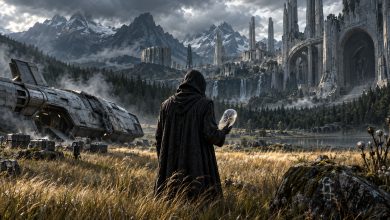
Byte-Sized Overview
After the faction system collapses, Tris Prior and Tobias “Four” Eaton discover that freedom has not brought peace to Chicago. Evelyn has replaced Jeanine Matthews as the city’s authoritarian leader, while Johanna Reyes and her followers prepare to resist her rule.
Determined to learn what exists beyond Chicago’s defensive wall, Tris, Four and several companions escape into the devastated landscape outside. They are rescued by the Bureau of Genetic Welfare, an advanced organisation that has secretly observed Chicago for generations.
Bureau director David explains that the city was established as a controlled experiment after genetic engineering caused widespread social damage. Its faction system was intended to produce people whose genes had repaired themselves naturally, and David believes Tris represents the experiment’s first completely successful result.
As Tris is welcomed into the Bureau, Four discovers that its supposedly scientific mission conceals abduction, surveillance and behavioural control. The pair must decide whether the world outside Chicago offers genuine freedom or merely a more sophisticated form of the system they have already escaped.
The Divergent Series: Allegiant
Release Year: 2016
Director: Robert Schwentke
Starring: Shailene Woodley, Theo James, Jeff Daniels, Miles Teller, Zoë Kravitz, Naomi Watts, Octavia Spencer, Ansel Elgort
Runtime: 121 minutes
Country: United States
Language: English
Production Company: Summit Entertainment, Red Wagon Entertainment, Mandeville Films
Subgenre Tags: Dystopian Science Fiction, Young Adult Science Fiction, Genetic Engineering, Social Engineering, Post-Apocalyptic Science Fiction, Action Adventure
Why The Divergent Series: Allegiant Is Worth Watching
Allegiant expands the world of the Divergent series beyond Chicago and reveals that the faction system was part of a much larger programme of genetic and social engineering.
The concept has considerable potential. Humanity attempted to eliminate undesirable characteristics through genetic modification, only to discover that changing individual traits caused widespread psychological and social instability. Cities such as Chicago were sealed off and monitored to determine whether generations of natural reproduction could repair the damage.
This revelation reframes the previous films. Chicago’s residents were not survivors who independently constructed a faction system after civilisation collapsed. They were research subjects inside a social laboratory, observed through hidden technology and judged according to standards they never agreed to.
The Bureau claims to have moved beyond the prejudice of the old world, but it has simply created new categories. People are labelled genetically pure or damaged, with the designation influencing their rights, opportunities and perceived human value. The language is scientific, yet the resulting hierarchy closely resembles every discriminatory system the Bureau claims to be correcting.
Shailene Woodley continues to give Tris a quiet determination that survives the screenplay’s extensive exposition. Tris wants to believe that her experiences have meaning, making David’s account of her genetic status particularly seductive. He does not merely praise her. He offers her a role in repairing humanity.
Theo James receives some of the film’s stronger material as Four. Less impressed by the Bureau’s technology and ceremonial attention, he recognises its methods through their effect on ordinary people. His suspicion creates a useful tension with Tris, although the resulting disagreement follows a familiar pattern from the earlier films.
The world outside Chicago also allows the series to adopt a new visual scale. The characters cross a toxic wasteland, encounter cloaked aircraft and enter an advanced facility built around surveillance screens, airborne transports and apparently effortless technology.
Unfortunately, much of this world feels more synthetic than convincing. Several landscapes and action sequences rely upon conspicuous digital effects, while the Bureau’s clean interiors lack the distinctive physical identity of Chicago’s faction environments.
The film’s greatest problem is structural. Veronica Roth’s final novel was divided into two planned films, leaving Allegiant responsible for introducing a new society, new scientific history and new antagonist without completing the conflict. The intended continuation, Ascendant, was never produced.
As a result, Allegiant ends after exposing its villain but before resolving the broader struggle. It remains watchable as an exploration of genetic classification and institutional control, but it cannot escape the feeling that an entire final act is waiting somewhere beyond the wall.
Deep Dive Highlights
- Chicago as an experiment: The city’s faction system was designed and monitored by outsiders rather than created solely by its inhabitants. The revelation turns generations of political conflict into data collected by an institution that never accepted responsibility for the suffering it observed.
- Genetic purity: The Bureau divides humanity into genetically pure and genetically damaged populations. Its terminology sounds clinical, but it assigns moral and social value to biology, converting genetic information into a new caste system.
- The Purity War: Attempts to remove aggression, dishonesty and other supposedly undesirable traits produced unintended consequences and contributed to global conflict. The premise challenges the idea that complex human behaviour can be separated into individual biological defects.
- Tris as a successful result: David tells Tris that she is genetically pure, validating her difference while reducing her to the outcome of an experiment. His praise is another form of classification, merely placing her at the top of the hierarchy rather than outside it.
- Four’s scepticism: Four judges the Bureau by its treatment of vulnerable people rather than its explanations. His response provides the film’s clearest moral perspective: advanced technology and scientific language do not make coercion legitimate.
- David’s paternal authority: Jeff Daniels plays David with calm reassurance rather than obvious menace. He presents manipulation as patient guidance, making his control over Tris more plausible than conventional intimidation would have been.
- The world beyond the wall: The toxic landscape immediately establishes that Chicago’s isolation protected its inhabitants from genuine environmental danger. Acidic rain, ruined cities and red wasteland replace the comparatively familiar streets of the previous films.
- Surveillance without intervention: The Bureau has watched Chicago’s wars, executions and political upheavals through hidden cameras. Its refusal to intervene exposes the moral failure of treating real people as experimental subjects.
- Memory technology: Chemical compounds allow the Bureau to erase memories and control populations without permanently damaging valuable infrastructure. The technology turns identity itself into something an authority can edit whenever resistance becomes inconvenient.
- The abduction of children: Bureau personnel remove children from settlements around the wasteland and erase their memories before absorbing them into the facility. The practice reveals that its genetic mission depends upon the same exploitation it claims will restore humanity.
- A divided Chicago: Evelyn and Johanna create opposing movements from the remains of the faction system. Their conflict demonstrates that destroying established categories does not automatically create shared government or trust.
- An incomplete adaptation: The film finishes by positioning its characters for a final confrontation that never arrives. This weakens both its immediate climax and its value as the concluding chapter of the screen trilogy.
Spoiler Mode
Following Jeanine Matthews’ defeat, Evelyn takes control of Chicago and dissolves the faction system. She establishes trials for former Erudite and Dauntless collaborators, promising justice while using public executions to consolidate her authority.
Caleb Prior faces execution for betraying Tris during the previous conflict. Tris and Four rescue him with help from Christina and Peter, then join Tori in an attempt to escape over the wall.
Evelyn’s forces pursue them. Tori reaches the top of the wall but is shot and killed by Edgar. The others escape into the wasteland, where toxic rain begins damaging their clothing and skin.
An advanced group retrieves them and takes them to the Bureau of Genetic Welfare. They undergo decontamination and learn that the outside world possesses technology far beyond anything available inside Chicago.
David, the Bureau’s director, explains that genetic experiments intended to improve humanity caused the Purity War. Survivors created isolated cities where supposedly damaged populations could reproduce over generations until genetically pure individuals emerged.
Chicago is considered the most successful experiment, and Tris is identified as genetically pure. Four, Caleb, Christina and Peter are classified as damaged.
David shows Tris the surveillance systems used to monitor Chicago. He argues that the Bureau could not interfere without permission from the governing council at Providence. Tris agrees to accompany him there and support his request for intervention.
Four is assigned to Bureau operations under Matthew and Nita. During a mission, he discovers soldiers abducting children from a wasteland settlement. The children’s memories are erased before they are taken back to the Bureau.
Four confronts Tris with what he has witnessed. She initially trusts David’s explanation that the procedure rescues children from dangerous conditions, creating tension between them. Four decides to return to Chicago and stop the conflict developing between Evelyn and Johanna.
David appears to help Four leave, but secretly orders soldiers to kill him. Four escapes and reaches Chicago with Christina.
Tris travels to Providence and discovers that David already possesses the authority required to intervene in Chicago. His supposed mission to obtain council approval was a performance intended to secure her cooperation and present the Bureau’s experiment favourably.
Caleb accesses the Bureau’s surveillance network and learns that David has provided Peter with an amnesia compound. Peter takes the weapon to Chicago and persuades Evelyn that releasing it will erase the loyalties and hostility dividing the population.
Peter believes David will reward him with a senior position once Chicago has been brought under control. David regards him as useful but disposable, continuing the franchise’s long tradition of institutions discovering that Peter will betray absolutely anyone when offered a better chair.
Tris, Caleb and Christina steal David’s personal aircraft and return to Chicago. They reunite with Four and attempt to prevent Evelyn releasing the memory gas.
Peter turns against Evelyn and seals her inside the control room as the compound begins flowing through the city’s ventilation system. Four breaks through the door, and Caleb helps stop the distribution before the entire population is exposed.
Tris uses the Bureau’s communications technology to broadcast David’s actions across Chicago and to the council at Providence. She reveals that the Bureau has manipulated the city, withheld assistance and attempted to erase its population’s memories.
She then addresses Chicago and announces that the city will no longer remain closed. Its residents will work together and welcome contact with people outside the wall.
At the Bureau, David watches the transmission and orders his staff to restore his reputation with the council. He prepares to continue his work, leaving the conflict unresolved.
The planned fourth film, Ascendant, was intended to complete the story. After Allegiant underperformed commercially, the project was reconsidered as a television production before being abandoned. The film series therefore ends with David still in power and Tris only beginning the struggle against him.
Core Question
Does prejudice become legitimate when it is expressed through scientific language?
The Bureau describes people as genetically pure or damaged, presenting these classifications as measurable biological facts. Yet it uses those categories to determine status, access and human worth.
Tris receives privileges because her genes fit the Bureau’s preferred definition. Four is treated as inferior despite demonstrating independence, loyalty and moral judgement. Their different treatment exposes how little the classification reflects the qualities that actually define them.
David’s system resembles the factions it was supposedly designed to study. Both reduce complicated individuals to a single label and interpret deviation as evidence of disorder.
The Bureau’s technology makes its prejudice appear objective. Genetic scans, surveillance systems and behavioural records create an impression of authority, but the conclusions drawn from that information remain political choices.
The film’s strongest idea is that scientific capability does not guarantee ethical wisdom. Data may describe biological differences, but it cannot decide what rights, dignity or value a person deserves.
Watch If You Like
- Divergent: The first film introduces Tris, Four and the faction system that the Bureau later reveals to be a controlled experiment.
- The Divergent Series: Insurgent: Tris’ conflict with Jeanine leads directly to the collapse of the factions and the opening of Chicago’s wall.
- The Maze Runner: The Scorch Trials: Young survivors escape a controlled environment only to discover a devastated outside world and another manipulative organisation.
- The Hunger Games: Mockingjay – Part 1: A revolutionary movement uses symbolism, surveillance and propaganda while competing authorities struggle to control a divided population.
- Gattaca: Genetic information determines social opportunity within a system that disguises biological discrimination as rational organisation.
- The Island: Residents of an isolated community discover that their environment and identities have been engineered for purposes concealed from them.
- The Giver: A controlled society suppresses memory, emotion and individual choice in the belief that stability justifies manipulation.
- Never Let Me Go: Human lives are assigned value according to their biology and the institutional purpose for which they were created.
Signal Strength
IMDb users currently rate The Divergent Series: Allegiant at approximately 5.7/10. Rotten Tomatoes records an 11% critics’ score and an audience score of approximately 41%. Its expanded world and central cast attracted some praise, but the artificial visual effects, exposition-heavy screenplay and decision to postpone the conclusion to another film received widespread criticism.
Zombie Head’s Take: Allegiant contains a genuinely useful science-fiction idea about genetic prejudice, then buries it beneath glossy technology, hurried exposition and preparation for a sequel that never turned up. Tris and Four remain worth following, but the franchise reaches the outside world only to discover an even larger supply of familiar dystopian corridors.
Zombie Head's independent editorial rating An ambitious expansion of the Divergent world with a worthwhile genetic-classification premise, undermined by artificial visuals, thin character development and the absence of a genuine conclusion.Zombie Head's Score
What works
What may not